
MECHANISM OF ACTION OF BEXLUTRY

SAME MECHANISM OF ACTION
BEXLUTRY DELIVERS PRECISE, TARGETED RADIATION TO SSTR+ GEP-NETs1
BEXLUTRY is a non-carrier-added radioligand therapy (RLT) that binds to somatostatin receptors (SSTRs) expressed on GEP-NET cells1,2
- A somatostatin analog (SSA) that binds selectively to somatostatin receptors (primarily SSTR2) expressed on NET cells
- A DOTA chelator, which securely links the SSA to the radioactive component, forming DOTATATE
- Lutetium-177 (Lu-177), a radionuclide that emits beta-minus radiation
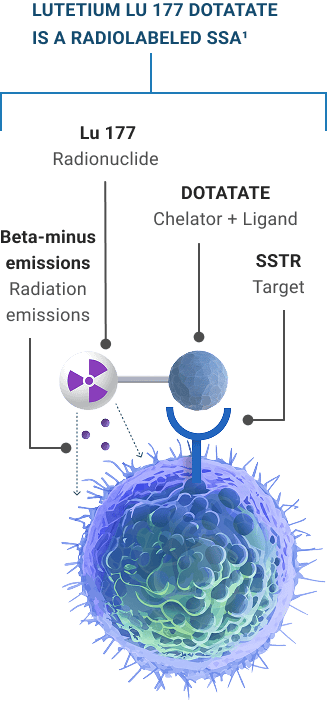
Lutetium Lu 177 dotatate undergoes receptor-mediated internalization, delivering targeted beta-minus radiation that causes DNA damage and leads to cellular death. While radiation from lutetium Lu 177 dotatate can affect neighboring cells, the short tissue range limits exposure to surrounding tissue.1,3,4
Abbreviations
DNA, deoxyribonucleic acid; GEP-NET, gastroenteropancreatic neuroendocrine tumor; NET, neuroendocrine tumor; SSTR+, somatostatin receptor–positive; SSTR2, somatostatin receptor 2.
Clinical data
Explore the efficacy and safety based on clinical trials of the reference RLT.

IMPORTANT SAFETY INFORMATION
WARNINGS AND PRECAUTIONS
-
Risk From Radiation Exposure: Bexlutry contributes to a patient’s overall long-term cumulative radiation exposure. Long-term cumulative radiation exposure is associated with an increased risk for cancer. These risks of radiation associated with the use of Bexlutry are greater in pediatric patients than in adults.
Radiation can be detected in the urine for up to 30 days following Bexlutry administration. Minimize radiation exposure to patients, medical personnel, and household contacts during and after treatment with Bexlutry consistent with institutional good radiation safety practices, patient management procedures, Nuclear Regulatory Commission patient-release guidance, and instructions to the patient for follow-up radiation protection at home.
-
Myelosuppression: In NETTER-1, myelosuppression occurred more frequently in patients receiving lutetium Lu 177 dotatate injection with long-acting octreotide compared to patients receiving high-dose long-acting octreotide (all Grades/Grade 3 or 4): anemia (81%/0) versus (54%/1%); thrombocytopenia (53%/1%) versus (17%/0); and neutropenia (26%/3%) versus (11%/0). In NETTER-1, platelet nadir occurred at a median of 5.1 months following the first dose. Of the 59 patients who developed thrombocytopenia, 68% had platelet recovery to baseline or normal levels. The median time to platelet recovery was 2 months. Fifteen of the nineteen patients in whom platelet recovery was not documented had post-nadir platelet counts. Among these 15 patients, 5 improved to Grade 1, 9 to Grade 2, and 1 to Grade 3. Monitor blood cell counts. Withhold dose, reduce dose, or permanently discontinue Bexlutry based on the severity of myelosuppression.
-
Secondary Myelodysplastic Syndrome (MDS) and Leukemia: In NETTER-1, with a median follow-up time of 76 months in the main study, myelodysplastic syndrome (MDS) was reported in 2.3% of patients receiving lutetium Lu 177 dotatate injection with long-acting octreotide compared to no patients receiving high-dose long-acting octreotide.
In ERASMUS, 16 patients (2.0%) developed MDS and 4 (0.5%) developed acute leukemia. The median time to onset was 29 months (9 to 45 months) for MDS and 55 months (32 to 125 months) for acute leukemia.
-
Renal Toxicity: In ERASMUS, 8 patients (< 1%) developed renal failure 3 to 36 months following lutetium Lu 177 dotatate injection. Two of these patients had underlying renal impairment or risk factors for renal failure (e.g., diabetes or hypertension) and required dialysis.
Administer the recommended amino acid solution before, during and after Bexlutry to decrease the reabsorption of lutetium Lu 177 dotatate through the proximal tubules and decrease the radiation dose to the kidneys. Advise patients to hydrate and to urinate frequently before, on the day of, and the day after administration of Bexlutry.
Monitor serum creatinine and calculated creatinine clearance. Withhold dose, reduce dose, or permanently discontinue Bexlutry based on the severity of renal toxicity.
Patients with baseline renal impairment may be at increased risk of toxicity due to increased radiation exposure.
-
Hepatotoxicity: In ERASMUS, 2 patients (< 1%) were reported to have hepatic tumor hemorrhage, edema, or necrosis, with one patient experiencing intrahepatic congestion and cholestasis. Patients with hepatic metastasis may be at increased risk of hepatotoxicity due to radiation exposure.
Monitor transaminases, bilirubin, serum albumin, and international normalized ratio (INR) during treatment. Withhold dose, reduce dose, or permanently discontinue Bexlutry based on the severity of hepatotoxicity.
-
Hypersensitivity Reactions: Hypersensitivity reactions, including angioedema, occurred in patients treated with lutetium Lu 177 dotatate injection. Monitor patients closely for signs and symptoms of hypersensitivity reactions, including anaphylaxis, during and following Bexlutry administration for a minimum of 2 hours in a setting where cardiopulmonary resuscitation medication and equipment are available. Discontinue the infusion upon the first observation of any signs or symptoms consistent with a severe hypersensitivity reaction and initiate appropriate therapy.
Premedicate patients with a history of Grade 1 or 2 hypersensitivity reactions to Bexlutry before subsequent doses. Permanently discontinue Bexlutry in patients who experience Grade 3 or 4 hypersensitivity reactions.
-
Neuroendocrine Hormonal Crisis: Neuroendocrine hormonal crises, manifesting with flushing, diarrhea, bronchospasm and hypotension, occurred in < 1% of patients in ERASMUS and typically occurred during or within 24 hours following the initial lutetium Lu 177 dotatate injection dose. Two (< 1%) patients were reported to have hypercalcemia. Monitor patients for flushing, diarrhea, hypotension, bronchoconstriction or other signs and symptoms of tumor-related hormonal release. Administer intravenous somatostatin analogs, fluids, corticosteroids, and electrolytes as indicated.
-
Embryo-Fetal Toxicity: Based on its mechanism of action, Bexlutry can cause fetal harm when administered to a pregnant woman. Verify pregnancy status of females of reproductive potential prior to initiating Bexlutry. Advise pregnant women of the potential risk to a fetus. Advise females of reproductive potential to use effective contraception during treatment with Bexlutry and for 7 months after the last dose. Advise males with female partners of reproductive potential to use effective contraception during treatment with Bexlutry and for 4 months after the last dose.
-
Risk of Infertility: Bexlutry may cause infertility in males and females. The recommended cumulative dose of 29.6 GBq of Bexlutry results in a radiation absorbed dose to the testes and ovaries within the range where temporary or permanent infertility can be expected following external beam radiotherapy.
ADVERSE REACTIONS
The most common Grade 3-4 adverse reactions (≥ 4% with a higher incidence in lutetium Lu 177 dotatate injection arm) reported in NETTER-1 were lymphopenia, increased GGT, vomiting, nausea, increased AST, increased ALT, hyperglycemia and hypokalemia.
With a median follow-up time of more than 4 years, the following rates of serious adverse reactions were reported in ERASMUS: myelodysplastic syndrome (2%), acute leukemia (1%), renal failure (2%), hypotension (1%), cardiac failure (2%), myocardial infarction (1%), and neuroendocrine hormonal crisis (1%).
DRUG INTERACTIONS
Somatostatin Analogs: Somatostatin and its analogs competitively bind to somatostatin receptors and may interfere with the efficacy of Bexlutry. Discontinue long-acting somatostatin analogs at least 4 weeks and short-acting octreotide at least 24 hours prior to each Bexlutry dose. Administer short- and long-acting octreotide during Bexlutry treatment as recommended.
Glucocorticoids: Glucocorticoids can induce down-regulation of subtype 2 somatostatin receptors (SSTR2). Avoid repeated administration of high doses of glucocorticoids during treatment with Bexlutry.
USE IN SPECIFIC POPULATIONS
Lactation
Advise women not to breastfeed during treatment with Bexlutry and for 2.5 months after the last dose.
Pediatric Use
Somatostatin Receptor-Positive Gastroenteropancreatic Neuroendocrine Tumors: The risks of radiation exposure associated with Bexlutry are greater in pediatric patients than in adult patients due to longer life expectancy. The safety and effectiveness of Bexlutry have not been established in pediatric patients younger than 12 years old with somatostatin receptor-positive GEP-NETs.
Pediatric use information is approved for Advanced Accelerator Applications USA INC’s LUTATHERA (lutetium Lu 177 dotatate) injection for intravenous use. However, due to Advanced Accelerator Applications USA Inc.’s marketing exclusivity rights, this drug product is not labeled with that pediatric information.
LUTATHERA® is a registered trademark of Advanced Accelerator Applications International SA.
INDICATIONS AND USAGE
Bexlutry™ (lutetium Lu 177 dotatate injection) is indicated for the treatment of adults with somatostatin receptor-positive gastroenteropancreatic neuroendocrine tumors (GEP-NETs), including foregut, midgut, and hindgut neuroendocrine tumors.
References
- BEXLUTRY. Prescribing information. Curium US LLC; 2026.
- Data on file. Curium US LLC.
- Ferro-Flores G, Azorín-Vega E, Ocampo-García B, Luna-Gutiérrez M, Cruz-Nova P, Meléndez-Alafort L. Effects of targeted radionuclide therapy on cancer cells beyond the ablative radiation dose. Int J Mol Sci. 2025;26(14):6968. doi:10.3390/ijms26146968
- Becx MN, Minczeles NS, Brabander T, de Herder WW, Nonnekens J, Hofland J. A clinical guide to peptide receptor radionuclide therapy with 177Lu-DOTATATE in neuroendocrine tumor patients. Cancers. 2022;14(23):5792. doi:10.3390/cancers14235792